Wednesday, January 11, 2012

Led Zeppelin and Tarot


When it comes to Led Zeppelin people like to, for lack of a better phrase, "tell me things."  The assumption always seems to be that they know secret things about the band that I'm just not aware of.  That tradition truly started about fifteen years ago at a small New Age/Pagan gathering in Lansing, Michigan.  I was sitting around, in a Led Zeppelin shirt* of course, minding my own business when a guy who looked like 1974 came up to me and said "Dude, did you know that the song Gallows Pole is a meditation on the Hanged Man tarot card?" Not knowing exactly how to answer, my younger (dumber) self mumbled something about how I was already aware of that, which I wasn't.
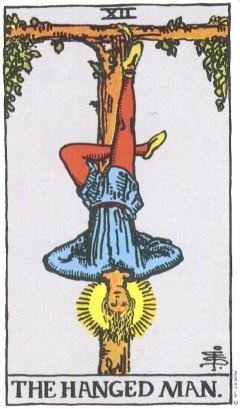
When I got home that night I dutifully went upstairs to my room, dug up the second CD from Led Zeppelin's 1990 boxed set, and sat down with the tarot's Hanged Man card.  I stared at that card for a good fifteen minutes, with Zep's Gallows Pole on repeat for the whole time.  I'm not sure what I expected to happen, but what I expected was certainly more than the nothing that occurred.  I'd move the card really close to my eyes, and then as far away from me as my arm would reach, and I did this over and over again trying to gain some divine insight into the world, Led Zeppelin, and the occult.  Thankfully, no one was around to watch my stupid card trick that evening.


Now there are as many interpretations of tarot cards as there are tarot decks, but it was always my understanding that the Hanged Man card represented something between the worlds.  The Hanged Man is not simply a soon to be corpse blowing in the wind, but a spiritual seeker, attempting to see the next world while on this plane of existence.  The Led Zeppelin song Gallows Pole ends with the protagonist dead as a doornail, with all of his attempts to get free of the noose an utter failure.  His brother brings gold and silver, his sister sleeps with the executioner, but he still winds up dead.  If that's a meditation on the Hanged Man card, I don't want to ever see it come up in a card reading.v

In truth, the song has nothing to do with the tarot and the songs original origins lie in Scandinavia where it was originally a 15th Century children's folk song with a much happier ending.  While the tarot predates the song (European style decks were in use by 1450, perhaps a few decades earlier), the cards were originally Christian symbols, and didn't receive their occult associations until the 1800's.  In a long and winding bit of evolution the song eventually migrated to the British Isles, and from there to North America.  In the late 1930's a version of it was recorded by blues singer Leadbelly, who dubbed the song Gallis Pole.  According to most Zep biographers Page was inspired to do the tune after hearing a version of the Leadbelly song recorded by California folk-singer Fred Gerlach.  However, author Mick Wall believes that Page nicked Zeppelin's version of the song from African-American folk singer Dorris Henderson, who recorded the song with Pentangle guitarist John Renbourne.  So Dutch song, then English folk song, then a blues tune, then an Americanized folk song based on the blues version.  Interesting history, but no tarot.  (Not that there's a lot of Dorris Henderson out there on the internet, but her voice was amazing.)

Led Zeppelin does has have a history with the tarot, it's jut not quite as spectacular as the dude stuck in 1974 would have had me believe.  Most of the association between Led Zeppelin and tarot is due to 1971's Led Zeppelin IV (also sometimes called Runes or Zoso in honor of the glyphs associated with it), and even some of that is wishful thinking.  At another more recent festival I had just finished up presenting my Led Zeppelin and the Occult workshop to 75 mostly non-napping people, when a young lady come up to me with a tarot card in her hand.  She wanted me to know that the figure on the front of Led Zeppelin IV represented the Ten of Wands.

According to Jimmy Page (guitar, and if you don't know who he is I have no idea why you are reading this) the cover to Zep IV came about when "Robert found the picture of the old man with the sticks and suggested that we work it into the cover somehow.  So we decided to contrast the modern skyscraper on the back with the old man and the sticks-you see the destruction of the old and the new coming forward."  I'm not entirely sure that's true either, but there is probably something to the claim of contrasting new and old.  The classic interpretation of the Ten of Wands has nothing to do with that balance, and instead represents either a large burden, or being unable to see the road in front of you (perhaps because of that burden).  The man in the picture is a little stooped over, but he doesn't seem especially troubled by it.


The card I was shown by the lovely lady in question that day did look a lot like the cover of Zeppelin IV, in fact, it looked almost exactly like it.  I was actually a bit stupefied that day thinking I had come across something I had previously been unaware of.  When I got back home after the festival I began researching the Ten of Cups and was disappointed to find that the reverse of what this girl had told me was true.  The cover of Led Zeppelin IV had inspired a reinterpretation of the Ten of Wands, and that the original Ten of Wands was something else entirely.  Since the Ten of Wands/Old Man Cover was brought to my attention I've seen multiple decks with sticks on the back, and all of them date to after Zep IV.  I think it's cool that Zeppelin inspired something, but it's not the cover of Zeppelin's fourth album that links the band to the tarot, it's the album's gatefold sleeve.


The most striking tarot related image in the Led Zeppelin catalog is on the gatefold sleeve of Zeppelin's untitled fourth album and features the Hermit from the Major Arcana.  Jimmy Page has been exceedingly blunt about the fact that it's the Hermit, “The inside cover was painted by a friend of mine. It's basically an illustration of a seeker aspiring to the light of truth."  (The work was credited to the artist Barrington Colby-Mom, who subsequently then fell off the face of the earth.)  The Hermit card must have been pretty important to Page, because he dresses up in hermit garb for a silly sequence in the Led Zeppelin concert movie The Song Remains the Same. Of course the Hermit represents the search for truth and wisdom, precisely the kind of soul searching that seemed to go into the lyrics of "Stairway to Heaven."  The Hermit on that particular album sleeve makes perfect sense when paired up with "Stairway," the ultimate song about soul searching.

After Led Zeppelin IV the band handed off the album cover art duties to the British firm Hipgnosis, who also designed album covers for bands like Pink Floyd.  I don't want to say that the tarot imagery stopped because of Hipgnosis, but it never graced the inside of a Led Zeppelin album again.  Perhaps just because it couldn't be topped, hard to say.  Page obviously remained proud of his association with The Hermit, appearing as the old wizard in 1976's The Song Remains the Same concert movie (though that sequence was filmed several years earlier), but was that the last explicit tarot reference in the music or art of Led Zeppelin, until possibly 2003.

On May 27 2003, Led Zeppelin released a two disc DVD set of live concert footage, none of which had been officially released to the public before.  To say that day was a national holiday for me is an understatement.  I took the day off from work to listen to "get the Led out" and listsen to Led Zeppelin literally all day.  Upon purchasing the DVD set I was struck by the cover art, featuring some old crumbling mountains standing alone, surrounded by desert.  The mountain in the picture doesn't look entirely natural either, it might be something that was carved by human beings.  It's old and crumbling, but still standing proudly, ravaged but remaining upright in the face of adversity.  It implies a certain eternalness, "age may weather me but I will still remain," type of thing.  This king of imagery is common on the tarot card known as "The Tower."


The Tower has several different interpretations in Tarot.  Some of them are quite negative, some more positive.  The original symbolism of the card probably relates back to the Tower of Babel, which would be fitting for the band that wrote and recorded Stairway to Heaven.  I'm not quite sure if the DVD art and the Tower card are related, but the base of the Tower and the base of the mountains on the DVD box tend to make me believe I'm on the right path.

No matter what all the art means in Zeppelin, the band does stand eternal.  Even now, forty odd years after their first record they continue to move three million albums annually.  That's impressive. Trends come and go, but Led Zeppelin remain, kind of like Tarot Cards.  


*All of my clothing either has rock band logos on it or sports teams stuff.

Wednesday, January 4, 2012

Jason's Charge of the God

I've always firmly believed that all male archetypes are a part of something greater, and that all roads lead back to the same place.  In other words I believe that all religions are valid, and all positive faiths can be seen as expressions of "God."  In Wicca, the feminine aspect of "The All" or "Prime Mover" is expressed in "The Charge of the Goddess."  The CotG was written and assembled mostly by British Witch Doreen Valiente (who shares a birthday with me!).  Her Charge has lots of "bits" in it, ideas incorporated from Gerald Gardner's earlier version, and words from Charles Godfrey Leyland's "Aradia" and the writings of Aleister Crowley.  What makes Valiente's Charge great has nothing to do with where the words came from, but everything to do with how those words were used to express universal truths.  

Many years ago I was writing a very big Beltane Ritual, and decided to include Valiente's Charge.  To counter-balance her expression of the Divine Feminine I searched in vain for something equally expressive of the Divine Male.  There are many "Charges of the God" out there, but they are all generally re-workings of Valiente, substituting male things in for female ones, while generally keeping Valiente's cadence and structure.  I thought that was lame and decided to write my own, to create something hopefully equal to Valiente's Charge, but unique.  The result is Jason's Charge of the God.

The Charge of the God

Revealed now are the words of the Great God.  He is the ancient one, whose face has appeared in many roles throughout eternity.  

I am he who abides in the deepest darkest woods.  It is my place to be with the creatures of the forest running in the cloak of blackest night.  With bow strung across my back I make my home with the Earth.  I am the defender of the sacredness of nature.  I am the Great God.

I am he whose light and warmth brings forth life from the soil.  My warmth is the covenant of union between Lady and Lord.  My brow is the radiant crown of summer, the glow about me my promise of eternal light.  I am the Great God.

I am he who is magick, creator of eternal energy, the catalyst of beneficial change for all who would walk in the Old Ways.  My whispers are those of tomorrows revealed and knowledge to be granted.  I am the power to see and do all things.  I am the Great God.

I am the trickster, scourge of all those methodical and overanalyzing.  I am the trouble in the best laid plans, the unexpected when all seems well.  I am the chaos in a world of balance.  I am the Great God.

I am he whose gift is the vine, the never ending chalice of intoxication.  My presents are those of joy:  wine, dance, and the freedom to be without care.  Merriment and mirth to me are great honor for the joy of the folk is my reward.  I am the Great God.

I am the cosmic god, one with all aspects of the universe.  It is the stars which provide the sparkle in my eyes, a multitude of planets make up my body, and a thousand suns burn together as my heart and soul.  I am the Great God.

I am he who abides in the skies, bringer of thunder and sender of lightning.  I give the blessings of rain to the parched and hungry land.  I command the winds that turn the seasons.  I am he whose face can be seen amongst the clouds.  I am the Great God.

I am the horned one, ancient god of fertility.  It is my seed which brings forth life in the great womb.  I am the bringer of physical pleasure, god of lust, god of the flesh.  I give the joys of bodily union to all who ask.  I am the Great God.

I am he that stands at the threshold of death, and life eternal.  I welcome those who have departed your world and bid farewell to those who return to it.  I guard the mysteries of the end and the wonder of beginnings.  I am the Great God.

Worship me side by side with the Lady.  Honor me and I shall abide forever within you.  For as long as tolerance, happiness, and righteousness exist, the true God will eternally reign.  I am love, I am eternal, I am a part of all things.  I am the Great God.

Given the structure of my Charge-stand alone verses-you can do a lot of things with it.  It can be read by two people, trading verses back and forth.  It can be re-arranged so that the last verse read coincides with whatever season you are celebrating.  When time is short you can even skip a few verses here and there, though I wouldn't skip my favorite ones (horned one, wine god, trickster, nature god).  Certain verses are for particular gods as well, and if you are doing a ritual in honor of Pan or Cernunnos you could save their verses for last, or insert their names into the proceedings.  (I give the joys of bodily union to all who ask, I am Pan, I am the Great God, etc.)   

So it's a pretty adaptable piece, and something I'm rightfully proud of.  You can also insert new verses into it here or there.  The following two verses are in my official hand-written version, but are rarely used by me these days.  The first of these two verses is obviously about Jesus, and reflects my crazy passion to include everyone and everything in my personal theology.  I've had some Pagans yell at me for it.  "We don't need forgiveness" they tell me, and then I remind them that the verse only says "and those that need forgiveness my receive it."   

The second of these two verses is a rather barbed expression of love.  I like love, I am in love, I like being in love, but it often makes us do silly (or stupid) things.  It can be a double pointed sword if not approached correctly.   

I am the sacrificial god, my blood is poured out upon the Earth so that the soil may be renewed, and those that need forgiveness may receive it.  I care naught for myself, only for those who serve me.  I am the Great God.

I am the god of love and the commitment between two individuals sharing heart, mind, bodies, and soul.  It is my arrows which awaken desire in the hearts of women and men,  and it is my poison which make the sane foolish in the name of love.  I am the Great God.


Thursday, December 29, 2011

Black Sabbath, The Occult, and the Origins of the Devil in Heavy Metal.

Without question, Black Sabbath is one of the all-time great rock bands.  They sit on the classic rock Rushmore, alongside bands like Led Zeppelin, Pink Floyd, and The Who.   The biggest difference between Black Sabbath and those bands is that Sabbath invented a sub-genre of music almost entirely on their own-Heavy Metal.  The Sabs were the first ever heavy metal band, and there’s very little debate about it.


Sabbath guitar player Tony Iommi almost single handedly created the genre when he was forced to start “down-tuning” his guitar after an industrial accident chopped off the tips of the fingers on his left hand.  That horrible accident changed the sound of Iommi’s guitar, making it deeper, darker, and kind of menacing.  (For those of you who don’t play guitar, I should probably elaborate a little bit.  Iommi uses his left hand on the frets of his guitar.  It’s that hand that he uses to press down the strings.  Down-tuning makes the strings lighter, and therefore easier to press down.  The reduced tension on the strings produces a lower sound.)  The change in Iommi's guitar tuning was the first part of the equation that would create heavy metal, the second part was the band’s aura, an aura created almost entirely out of the public’s perception that Black Sabbath was a Satanic rock band.

There are a lot of people out there who think that Sabbath was the first in a long line of bands influenced by Lucifer.  The truth of it is that Sabbath came to Satan’s table kind of late, and they only came to it grudgingly.  There had been a couple of major label bands before Sabbath that very publicly embraced the Devil.  The first was the American Midwestern band “Coven.” Their first album, Witchcraft Destroys Minds and Reaps Souls, sounded like middle of the road 1969-hippy music, but the band looked like agents of the dark one on the cover, clad entirely in black standing next to a skull.  The album even featured a recording of a “Satanic Black Mass” on side two.  Despite being released by a mainstream record label, the album was quickly forgotten, though the band did initially attract a lot of media attention.

The gatefold sleeve to WDMaRS featured a scene from the "Black Mass" on the album.  What's most striking, aside from the naked woman of course, are the devil (or metal) horns being waved by the participants.  (Look at their hands, not their heads!)  In a bit of revisionist history Jinx Dawson, lead singer, would claim that she was the inventor of the metal horns, and was the one who popularized their use.  While she might have used them, they didn't really catch on until the early 80's when they were being used by Ronnie James Dio, in, you guessed it, Black Sabbath.
Weirdly, Coven would have hit with a cover of the song "One Tin Soldier" from the movie "Billy Jack," in 1971.  By this time the band's earlier Satanic associations were being downplayed.

The second rock band to openly embrace the occult, was the English Black Widow (yes people confused them a lot with Black Sabbath back in 1970).  While Black Widow sounded more like Jethro Tull than Black Sabbath, they were often taken for a heavy metal band, saxophone solos be damned!  Black Widow scored a minor hit in Great Britain with Come to the Sabbat (which I kind of like) off of their debut record Sacrifice.  Black Widow played the Satan stuff up to the hilt, even going so far as to conduct black masses between songs in concert.  Lyrically, the songs have almost a Pagany vibe, that is before the choruses kick in calling for Lucifer.

While Black Sabbath would cultivate a rather sinister image, much of that was unwarranted.  Certainly the name “Black Sabbath” is not a beacon of light, but it certainly wasn’t meant to be an ode to the black mass.  Black Sabbath was a compromise name, as the band was originally named (the very hippy sounding) Earth.  The only problem was that there was another band in England already named Earth, so they ended up having to change the name.

There’s a bit of controversy over where the name Black Sabbath actually came from.  There are some claims that the band was named after the movie “Black Sabbath” starring  Boris Karloff, and there was also a book by the same name from the pen of horror writer Dennis Wheatley.  Bass player Geezer Butler was certainly a fan of Wheatley’s so it’s quite possible that the name came from there.  As early as 1969, “Earth” was also playing a tune called Black Sabbath, another possible source for the band name.  It’s not unreasonable to suggest that all three factors played a part in Earth becoming Black Sabbath.

While the first Black Sabbath album (imaginatively named Black Sabbath) doesn’t endorse Satan, record label Warner Brothers tried to make it seem as if the band did.  An early record release party held in Los Angeles (minus the band in attendance) featured an appearance by Satanist Anton LaVey, which dogged the band for years.  The British release of the album (courtesy of Vertigo Records) featured an upside down cross on the inside record sleeve.  Such flourishes, made without the band’s consent or permission, did more to perpetuate the idea that the band was “Satanic” than anything on the album musically.


The album was certainly influenced by the occult, and Geezer Butler and Tony Iommi have admitted to being interested in such things during the band’s early days.  Iommi has said that there was “a lot of interest, not practice, but interest.”  Most of the interest was confided to Butler who according to Iommi “would do stuff like that, have all his candles burning.  Black Walls.  He would live the part.  We used to go around the black magic shops as well.”  Such things certainly weren’t typical in England circa 1969, but they weren’t completely out of place.

Humorously enough it was Ozzy Osbourne (lead singer) who would get saddled with the most amount of Satanic garbage over the years.  The singer was never into the occult like Butler, and has been quoted as saying “the only time I’ve ever been into black magic has been while eating a box of chocolates.”  Certainly the “Prince of Darkness” shtick has served Osbourne well over the years, but the occult was never his forte.

Ozzy’s greatest contribution to the band on that first album, aside from his vocals, might have been the lyrics he crafted to the song Black Sabbath, one of only three times Osbourne actually wrote lyrics while in Sabbath.  Though the tune is certainly creepy, and rather chilling, it was an ode against dabbling in the occult, not an endorsement.  Ozzy’s lyrics, with lines like “please God help me” came about due to an episode Butler had with a sinister presence.

According to Butler: “Ozzy brought me this really old black magic book, and it was all in Latin and Greek or whatever.  Somebody had lent it to him, and he knew that I was interested in all that stuff.  I was looking through it, and then I hid it in a cupboard, where I was living.  Because I just got a weird feeling from it.  And the next day I went to get it out from the cupboard, to reread it, and it had disappeared.  Completely gone into thin air, and it just me living there at the time.  And then, I was lying in bed one night and I just felt this presence.  I woke up and I saw this black shape, standing at the bottom of me bed staring at me, and it just totally freaked me out.  This was like 1969.  I told Ozzy about it, and that was when I went off black magic.  I took it as a warning to get out while I can."

While Geezer might have been looking to get out in 1969, the first album does contain a tune written from the Devil’s point of view.  According to Butler (primary lyricist for the band) N.I.B. was originally written to be a humorous song about Satan falling in love with a mortal woman, but somewhere along the line the humor got lost somewhere.  That’s not to say the song is an evil one, it’s a rocking one, but lines like “I will give you those things you thought unreal.  The sun, the moon, the stars all bear my seal” certainly conjure up dark vistas.  Osbourne’s cry of “My name is Lucifer please take my hand” probably helped to inspire a cadre of young Satanists who didn’t take his warning in Black Sabbath seriously.  N.I.B., named after drummer Bill Ward’s face looking like a pen nib, was about as dark as Sabbath ever got, and as far as darkness goes, it was pretty lukewarm.  When Ronnie James Dio joined the band in 1979, he would sometimes refer to the track as Nativity in Black, an awesome name, but not what Butler originally had in my mind for the song.  

By the time Sabbath’s second album, Paranoid, rolled out in the fall of 1970 the band was already desperately trying to get away from their Satanic-occult tinged image.  One of the early standout tracks on the album, Walpurgis, had all of its original lyrics thrown out and was turned into the colossal War Pigs.  The lyrics to Walpurgis told the story of a group of witches making sacrifices to Satan.  Lyrics like “Carry banners that denounce the Lord” and “On the hill the church in ruin is the scene of evil doings” would have been at home next to Black Sabbath and N.I.B., but Sabbath was desperately trying to move beyond that.  The only line that survived during the transition from Walpurgis to War Pigs was "witches at black masses."

Like most bands who write about the occult early in their career, Sabbath moved away from that initial inspiration (or in Ozzy’s case, fear) and found other things to write about.  Science fiction and fantasy were certainly inspiration, drugs another.  Even sinister sounding songs like Children of the Grave ended up being about love.  While the occult would long be associated with the band, the first incarnation of Sabbath moved quickly away from it, and by 1971 had penned a tune on Master of Reality that would have been at home on most Christian rock records.

Yes, you read that last sentence right, Sabbath moved so far away from the occult that they were actually endorsing Christianity just two short years after N.I.B.  After Forever was all about accepting Christ and saving one’s soul.  Butler’s last verse in After Forever really does lay the cards out on the table when it comes to Black Sabbath and the occult: “Perhaps you'll think before you say that God is dead and gone.  Open your eyes, just realize that he's the one.  The only one who can save you now from all this sin and hate.  Or will you still jeer at all you hear? Yes - I think it's too late."

The lyrics to After Forever shouldn't be all that to surprising to anyone who has actually bothered to look at a picture of Black Sabbath.  From the very start all four members were often seen wearing giant crosses around their necks.  Those crosses were given to the band by Osbourne's father, and from that moment on Sabbath used the cross on stage designs and concert t-shirts.  The crosses were never worn upside down either.

While the first lineup of Black Sabbath would go on to release five more albums after Master of Reality (a few of them classics), none would ever be as popular as the first three records.  The occult overtones died out as well, even if the media still liked to portray the band in that light.  After the dissolution of the original band, Iommi would find the occult again, but only in order to sell more records as he tried to steer the band in the direction many in the public expected it to go.  Some of the post-Ozzy Sabbath albums are classics too, especially the stuff with Ronnie James Dio, but the chills created by songs like Black Sabbath became a thing of the past.

Ozzy tried extremely hard to replicate the menacing atmosphere of Sabbath’s early days, and succeeded early in his career.  Songs like Mr. Crowley (about who else?  Aleister Crowley) shocked parents and tantalized teens who dreamed of dabbling with the occult, but Ozzy was never an occultist, and while the trappings helped to sell albums, it was obvious in interviews that he was never into that lifestyle.

While the guys in Black Sabbath were never occultists, nor did they worship the Devil, they did help to create the perception that good heavy metal bands did do those things.  In doing so, they defined metal as a genre against authority, which it remains nearly forty years later.

Friday, December 23, 2011

I'm Dreaming of a Green Christmas


For reasons I've never entirely understood, the Holiday Seasons has become intertwined with Winter and snow.  You may be thinking to yourself, "Jason, that's because Christmas occurs in Winter," which is true, but do you expect a ninety-five degree day the first day of Summer?  Is it magically warm and sunny on the first day of Spring?  Of course not, but during the Holidays the expectation that Winter will be in full roar on December 25th is pretty standard.

In some ways Christmas is a late fall holiday, it's only a couple of days removed from the Winter Solstice after all.  The coldest days lie ahead for most of us this time of year (think the horribleness of February), and while the days may be getting slightly longer, the worst is still in front of us.  Turning Christmas into a Winter Holiday has been horrible for the human psyche.  We've turned The Holidays into a Winter Carnival, and then after the first of the year we want to immediately dismiss Winter when it's only just begun.  The good parts of Winter are only celebrated at the start of the season, and then everyone starts wishing for Spring.  Keeping the Christmas Lights up into February would make the most depressing time  of year less depressing.  If Christmas is going to be a Winter Holiday Par Excellence we should move it to Imbolc (Feb. 2).

Living on the West Coast the expectation of a White Christmas is extremely bothersome, and represents one of the worst examples of East Coast Bias.  "Since it snows in New York, the expectation is that it snows everywhere," which is absolute bunk.  The majority of Americans will not celebrate a White Christmas this year, and the majority of Americans will not celebrate a White Christmas next year either.  While it's true that many states do get snow on Christmas, there are an equal amount of states that do not, and just because a state can get snow doesn't mean that it will.  Think of all the places that will never have (or have a very low probability of having) a White Christmas:  Atlanta, Miami, Orlando, Dallas, Los Angeles, Phoenix, San Francisco, New Orleans, Houston, San Diego, Mele Kalikimaka to you all.  

I don't begrudge people their White Christmas, it's fine, and snow is really pretty, I just wish the media would start showing some images that reflect the reality of what most Americans encounter in late December.  Even while living in Michigan, a White Christmas was never a sure thing, and we certainly had our share of Brown Christmases (a Brown Christmas:  a winter day without any snow or living plant life), as most Snow Belt residents do.  I grew up in Tennessee (just outside of Nashville) and we never had White Christmases there either (unless you got up early enough to catch the last bit of frost on the lawn) and those are some of my most memorable holidays.  Getting a new bike for Christmas in Tennessee meant I could ride it on Christmas Day, sure it was a bit chilly, but it was entirely possible, and like getting a second gift entirely.


 About the only other image ever associated with Christmas is the "Ironic Southern California/Hawaii" image.  Either the "Look we are celebrating on the beach!" picture or the "Aren't we clever we've got a palm tree for a Christmas Tree!" photo.  Out here in Northern California we have plenty of lit up palm trees, but you'd be an absolute fool to unwrap presents on the beach today.  It was 37 degrees this morning, and those Pacific Ocean Breezes aren't warm or soothing, they are cold and nasty.  My holiday will be similar to the holiday most Americans experience, a chilly one (at least in the morning, it'll probably get to sixty by 2:00 pm), and one without snow.

I'm probably only harping on the White/Green Christmas thing because it's causing conflict with my internal seasonal clock.  I keep seeing all of these images of snow, and there is no snow out here, nor will there be.  These images create the expectation that there should be, and the odds are better that I'll find a Sasquatch in my backyard than a snowflake in the sky.  If you are reading this in New Jersey and find my anger at East Coast Bias irritating, think about our situations if they were reversed.  What if the Los Angeles palm tree model of Christmas was dominant, and you were bombarded with that image while you had snow on the ground?  Wouldn't it be annoying?  Wouldn't it disrupt your seasonal expectations?  Of course it would.

If you have a White Christmas I hope it's gorgeous and I wish you all the best.  Just be careful while driving, and don't throw out your back while shoveling all that snow.  I'll have a Green Christmas, surrounded by blowing leaves, palm trees, and winter flowers.  I'm going to be celebrating a Green Christmas out here even though the media says that the idea should be depressing, and yet somehow it's not, I just wish they'd show the rest of the country how joyful it is NOT to have snow on the ground.  


Friday, December 16, 2011

Religion on the Public Square-On Nativity Scenes, Mithra, and more.

I think that I'm kind of an anomaly in Pagan circles, I believe that religion "on the public square" is a good thing.  I'm not necessarily opposed to the idea of Nativity scenes on public property, as long as every other faith has a chance to put their faith on display as well.  The baby Jesus in the manger is fine by me, as long as it's flanked by a menorah and a sign that says "Happy Yule."  Unfortunately, when you put religion on the public square, you get more than just shared Holiday Greetings, you often get deliberate antagonism.

This was vividly illustrated in a recent Associated Press story about the displacement of several Nativity/Christmas scenes at a coastal park in Santa Monica California.  The park allows for twenty-one displays, traditionally fourteen of them have been given to local churches who tend to put up Nativity scenes (they are churches, I can't say I'm surprised). This year the system changed and the twenty-one caged display areas were subject to a public drawing.  Out of the twenty-one available spots, two went to Christian churches, one went towards a Menorah, and the rest went to two atheists (one person can request up to nine spaces, two people got nine spaces a piece).  There are displays in three of the eighteen spots claimed by the atheists.  This angered a lot of churches, many of which had been putting up displays at this particular park for over 57 years.  

If you are wondering whose side I'm on, I'm on the side of the Christians. I have no trouble with atheists wanting to put up a display over the holidays, but I do think it's really a dickish move to claim a bunch of space with the intention of not doing anything with it.  There are no rules requiring them to give back their unused spaces either, so the spaces just sit there, empty.  This is obviously a petty move by some small minded people, and it makes me angry.  I have many atheist friends who behave rationally, but people like this, who just go out of there way to mock religion, I have very little tolerance for.  Remember Pagans, these are people who are going to make fun of your beliefs as well.  I know a lot of you out there tend to sympathize with atheists, and we often have common cause, but not in cases like this.

It's not just the unused spaces that bothers me either, it's the way atheists like this shape their message.  As you can see in the picture above, the banner says "What myths do you see?*"  That's not a holiday greeting, and it's not going to make a Christian suddenly say "Oh, Jesus is a myth?"  It's designed to provoke, and it's certainly out of line with what many of us think The Holidays are about.  What's wrong with a sign that simply says "Happy Winter Solstice" or "Happy Holidays?"  Why does it have to be a sign that belittles someone else's beliefs?

Last year in Florida there was a yard sign battle between Christian groups which were distributing "Jesus is the reason for the season" signs and an atheist group which was distributing "Mithra is the reason for the season."  Both sides were wrong of course, Saturnalia predates both the myth of Jesus' birth and the myth of Mithras' birth.  I know many Pagans get a kick out of such signs, but the atheists who are displaying them aren't endorsing Paganism, they are using those signs to mock both Pagan and Christian beliefs!

The Christian reaction can also be a bit ridiculous.  Last year the Catholic League put up a bunch of "Jesus is the Reason" billboards in various parts of the country to battle the atheists.  Instead of saying something nice the tagline is "You Know it's Real," which is especially hilarious given the depiction of Mary and Joseph.  It's good to know that Mary is still 100% European, and a full grown adult, because in Palestine two thousand years ago only twenty-four year old women were having babies.  (Mary probably would have been fourteen, people just got married early back then.)  If you are going to tell me that something is real, at least get your basic historical facts straight.  

Personally, I'm well aware that the majority of trappings in the Nativity story are Pagan.  Miraculous conception?  Pagan.  Celestial events at birth?  Pagan.  Born in a cave?**  Pagan.  Miracles like talking animals surrounding the birth?  Pagan.  Pagan Astrologers giving the baby presents?  Perhaps not Pagan, but it features Pagans!  Pretty cool.  I tend to only see my own faith reflected in most Nativity scenes.

The best way to deal with the Holiday Season is not to over-react.  I wish more people would look for the things we have in common instead of the things that separate us.  I disagree with a great many things in the Bible, but I do agree with "Do unto others as you would have them do unto you."  As a Pagan if I got some public space for The Holidays, my message would simply be "Happy Yule" with a Christmas Tree.  Yule is our word, and so's the tree.  Why start a war?

If I were an atheist and I wanted my beliefs respected, perhaps I'd use all the display space I received in Santa Monica to tell the true story of Christmas, that it's a holiday that has evolved from many different traditions.  If you want someone to come around to your point of view, try doing something other than making them angry.  

I love the Holiday Season, and I'm one of those idealists who thinks that it's something that can unite us: Christian, Pagan, Jew, and atheist alike.  Instead of uniting us though, the Holidays are always co-opted by loud fringe groups on both sides who simply want to use it for their own purposes.  Atheist groups which put up signs saying "Why myths do you see" aren't trying to unite anyone, and neither is the Catholic League.  Why we have to fight during one of the loveliest times of the year will always be a mystery to me.  


*There's a lot of bullshit in that banner too.  Certainly the birth narratives of Jesus belong in the realm of myth, but the majority of scholars think he was a real person.

**The New Testament says Jesus was laid in a manger, it doesn't say he was born in a barn.  A lot of early depictions of the Nativity have the little guy being born in a cave.

Thursday, December 15, 2011

Christmas Is Not Yours or Mine-It Simply Is

This is one of the best things I've ever written, and while it was originally published elsewhere, I think it's worth revisiting.   


My family moved to Wytheville Virginia when I was in the fifth grade.  Until that time, I had lived my entire life in the Midwest.  To say that Virginia presented a few culture shocks would be an understatement.  In the Midwest, school and religion did not mix.  Sure we sang Christmas Carols and had holiday parties, but we didn't read the Bible in class, nor watch fanciful filmstrips full of Christmases that never were.

One of the more memorable "fanciful filmstrips" was called "The Pilgrim's First Christmas."  I don't remember a whole lot about it, but I do remember the Pilgrims celebrating Christmas, making small presents for each other, and probably converting a few Native Americans along the way.  It was a rather cozy story, and nothing about it really rang false at the time.  Haven't people always celebrated Christmas?  Wasn't it all about Jesus at the start with the rest all added later?

If you actually read my notes on Facebook, you know that I'm obsessed with holidays.  I love Thanksgiving, revere Christmas, still celebrate Easter, and Ari and I go out every Valentine's Day to celebrate.  I love holidays, and while some people might play video games, or collect stamps, I research the histories of religion and holidays for fun.   I think it's a nice, normal, hobby, don't you?

This leads me back to the Pilgrims and the filmstrip glamorizing their holiday celebration.  Actually, "glamorizing" is probably the wrong word, the phrase "making up" would be more appropriate.  The Pilgrims didn't celebrate Christmas at all and until the middle of the 19th Century most Americans didn't either.  Christmas as we celebrate it today is a rather "new" holiday.  The traditions we most associate with it are only a few hundred years old.  Despite how universal and timeless it feels, it's never been universal or timeless.

Sure, by the Fourth Century there were Christians celebrating "Christmas."  It wasn't so much a celebration of Jesus' birth but a Christian continuation of the Roman holidays of Saturnalia and the January Kalends.  Saturnalia featured many of the things we currently associate with Christmas:  large meals, holly, mistletoe, gift giving, and abundance.  There was no way anyone was going to convince newly Christianized Romans to give up their holiday celebrations, so they became a part of the new holiday of Christmas, a day to celebrate the birth of Jesus.

December 25th wasn't a date picked by chance either, it was the birthday of Sol Invictus, the Unconquerable Sun, a pagan deity who was very popular with the elite of Rome and those in the army.  Other deities who celebrated a birthday that day were the Persian Mithras and the always popular Greek Dionysus.  With Jesus' birthday on the 25th the feasting, drinking, and gift giving was all allowed to continue, and people could all participate while paying a little lip-service to Jesus.

As Christianity spread across Europe it "Christianized" other winter festivals, adding their pagan elements to a day allegedly about the birth of Jesus.  The Norse Yule was turned into Christmas, moving from the winter solstice to the 25th.  Very little else about the holiday changed, gifts were still given out, branches and small trees continued to decorate homes, and solar imagery still abounded.  There was no rush to put up nativity scenes in place of the pagan fir trees and branches, Yule might have been called Christmas by some, but it was celebrated the same way.

In the 16th Century the first real war over Christmas was fought, and it was a battle between Christians.  Despite the yelling to the contrary, there has never been a war against Christmas fought by the forces of secular humanism, liberals, and atheists.  Generally the war against Christmas has pitted Christian against Christian.  The first salvo was fired by the English Puritans who waged such a successful campaign that Christmas was literally a forgotten holiday in most parts of England and North America until the 19th Century.

The Puritans suppressed Christmas because they knew it for what it was, a pagan midwinter holiday.  They objected to the pagan imagery, the feasting, drinking, and gluttony.  Due to their influence Christmas became a rather localized holiday in the early days of the United States.  It was celebrated by the Germans and the Dutch, but was forgotten or seen as a small potatoes by the majority of the population.  The United States Congress regularly met on Christmas until 1855, and children in Boston went to school on the 25th up until 1870.  The first state to declare Christmas a holiday was Alabama, and that was in 1836!

One of the exceptions to this rule was the former Dutch colony, New York.  New York City played a major role in establishing Christmas as a national holiday, and none of that had anything to do with Jesus.  The Dutch continued celebrating the midwinter celebration of Christmas long after it had gone out of fashion in England.  When the Dutch settled the "New World" they brought their traditions with them.  One of those traditions was of a mystical gift-giver related to the Turkish St. Nicholas.

Sinterklaus (later Santa Claus of course) was distantly related to St. Nicholas, but he was also related to the Norse god Odin.  St. Nicholas was a gift giver (and lots of other things, as one of the most popular Christian Saints, he's associated with nearly everything), and was often depicted with a long white beard, but so was Odin, and Odin road a horse, much like the early Sinterklaus.  By the time Sinterklaus came to the United States he was no longer like a god or a saint, Clement Moore in "The Night Before Christmas" described him as a "right jolly old elf."  Eventually the Saint Nick of the poem, and the Sinterklaus of Dutch legend became simply "Santa Claus."

"The Night Before Christmas" went on to become the best known poem in the English language, and it's popularity helped to spread the celebration of Christmas.  If you were a kid and heard that poem, wouldn't you want to celebrate Christmas?  Santa became the reason for the season, and the holiday spread because of Kris Kringle.  Without Santa Claus, it's possible that Christmas would have remained a forgotten holiday in the United States.

At the same time the United States was wrestling with Santa and adopting the holiday as its own, Christmas was re-awakening in Great Britain.  The great Christmas re-awakening can be attributed to two things:  Charles Dickens' "A Christmas Carol" and Queen Victoria's husband Prince Albert.  Albert was German, and celebrated the holiday of Christmas just like he did back home in Germany, with gift giving and trees, much like the Vikings did before the coming of Christianity.  As a celebrity, he was copied by many in England, and the United States.

Dickens' tale, while it didn't invent the modern Christmas, went a long way towards establishing it as a major holiday.  "A Christmas Carol" makes no references to Jesus, and is strictly a secular take on the holiday.  It has more in common with the ancient Roman Saturnalia than any celebration contemporary to Dickens.  When you get past the ghosts (one who looks very much like the Roman Bacchus), you have a tale full of gift giving, feasting, family, and drinking.  The scene where Scrooge sticks his head out of the window and has a boy run to the butcher shop for him is especially telling.  Didn't it ever strike you as odd that the butcher shop would be open on Christmas?  That's because no one was celebrating it at the time, and if they were, it wasn't the festival it is today.

Due to Dickens, Albert, and Moore the tradition of a Midwinter holiday was re-established in the 19th Century, but capitalism would play a major role in shaping the holiday.  As Christmas grew in popularity, manufacturers began to stress the "gift giving" part of the holiday.  The Industrial Revolution provided the Western World with all kinds of goodies that needed to be sold, and Christmas became a prime opportunity to do so.  Retailers and advertisers spread the word of Dickens' Christmas and used Moore's Santa Claus to sell more toys.  The role of capitalism cannot be overstated, Christmas rolled into every nook and cranny of our lives because people wanted to sell things, and then people wanted to get things, and the holiday took off.

Despite the holiday's initial newness in the United States we have a tendency to romanticize a Christmas past that never was.  Christmas can certainly be about faith and family, those are good things, and I'm glad there's some emphasis on that in the holiday, but it's never been exclusively about that, and wasn't designed for it.  Christmas is a secular holiday through and through (though dressed in mostly pagan outerwear), and it's key building blocks almost never reference Jesus or a manger.

There has been a renewed emphasis in some Evangelical and Catholic circles to "Put the Christ back in Christmas," but the truth is he never was there.  The battle has always been to "Put Christ into Christmas."  There is no "back" about it, he's basically been absent the entire time.  The real War on Christmas is being fought by people suffering under the delusion that it's always been a religious holiday. If there's a "War on Christmas" it's being fought by Christians who are trying to rewrite a secular past and replace it with a religious center that never was.

I  often find myself straddling a strange fence during the holiday season.  I'm certainly not offended when someone wishes me a "Merry Christmas," nor do I think that the use of the word Christmas in some way walks over my spiritual beliefs.  On the other hand I dislike hearing about Jesus being the sole "reason for the season", when he's kind of a late addition to the party.  In many ways, Christmas is what you make out of it.  If, for you, it's a celebration of Jesus' birth, that to me is awesome.  Have at it, and I hope your Christmas is spiritual and meaningful.  On the other hand if it's a secular celebration of Midwinter, good for you, that's what it's always been.  Christmas is not yours, or mine, it simply is, and I kind of like it that way.

Friday, December 9, 2011